The Challenge
So, my group the Will Chen Trio was in the planning stages of recording our first "album" (more like an EP, but not sure if any of these terms really apply in the digital age) and the age old question was number one on the list, how are we going to afford this? While the cost of tracking in a studio has come down significantly so has the experience of the hands behind the faders. Sure, a studio may have cheap rates but can you trust them? There are a ton of start-up studios which are nothing more than a pile of debt and a hobby. And even booking off hours at the bigger studios cost a pretty penny when you calculate the amount of time of setting up, tracking, and mixdown. I've recorded bands I've been in the past so decided to give it a shot again. One issue...I'd sold off my multichannel interface and laptop and my little bedroom studio isn’t sufficient for tracking drums. So I began looking at my options and happened across the Zoom R16 which seemed like a dream come true...
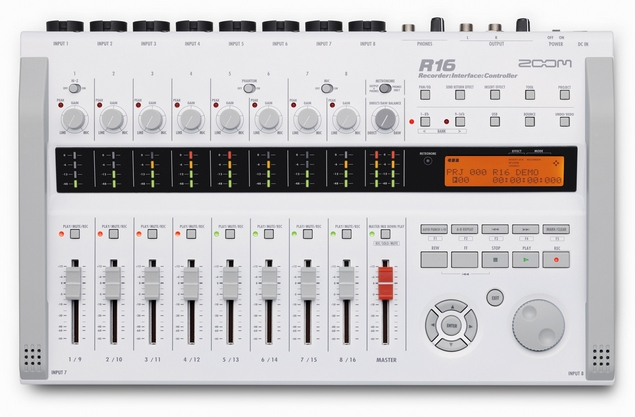
A Solution?
The Zoom R16 is a multipurpose device which can function as a 8 in, 2 out mixer, a USB interface for your computer based DAW (digital audio workstation), a control surface for your DAW, or on its own as a 16 channel DAW (8 channels recordable at once). To top it all off, it’s 100% portable as it can be powered on 6 AA batteries and it has a street price of ~$399 (mine was a B-stock in perfect condition for $319). All eight inputs are XLR/¼” line combo jacks with individual trim knobs. Two of the eight inputs have phantom power and another two can be assigned to two built in condenser microphones. Additionally, input one can be switched between standard and Hi-Z modes allowing an instrument to be plugged directly into the unit without a direct box. The R16 is also loaded with a bunch of effects covering everything from bass and guitar amp modeling to reverbs and delays which can be assigned as aux sends or directly to the inputs. Sounds are recorded to an SD card and the R16 supports sizes up to 32 GB (a 1 GB card is shipped with the unit). However, Zoom really put a lot of forethought into the unit as you can plug in any USB storage device into the R16 such as a flash drive or even a external hard drive. And if all that wasn’t enough, you can slave a second R16 via USB to create a 16 input 32 track completely portable system. Very smart!
Trial by Fire
As I’ve had a bunch of experience with older cassette based multi-trackers as well as modern DAW systems, I figured I’d dive right in and put the unit to the test in a trial by fire situation. So tracking my group would be the first time I ever powered on the R16. I briefly consulted the first page of the manual which is essentially a quick start guide and was up and running. One little personal niggle here, I’m color deficient (I see colors, but not the full spectrum like others) and red/green leds always give me a hard time so its a bit of a pet peeve of mine when they are used for critical functionality in electronics gear and the R16 uses them for arming tracks. After consulting my drummer Dave several times to ensure I had the tracks armed and unarmed as needed I memorized the number of pushes from the off state to set the tracks to play, rec, or mute. So, we literally dove right in and I must say the results were very pleasing. In fact, I must say my expectations were surpassed. While I’m sure the preamps don’t compare to high dollar dedicated units, they’re certainly capable of delivering solid tones which are reasonably transparent and totally usable. That’s quite a feat considering the cost to feature ratio. And the built in headphone jack provided enough level for me to monitor myself in the same room as the drums were being tracked (granted I was using closed back Sennheiser HD280 Pro headphones). Unfortunately, bass had to be tracked separately due to scheduling conflicts and the portability of the unit really came in handy. Our goal was simply to use the unit to track on location and then mix back on my Reaper based DAW and the R16 passed the test with flying colors. Not even considering the additional effects and mixing capabilities the unit was a big win and well worth the money spent.
[The R16] is the kind of device I would’ve killed for as a teen when I was tracking on four track cassette recorders which was an exercise in infinite aural compromises
Speaking of the effects, the quality is actually really nice. Zoom has served up 3 separate effects processors, a globally accessible reverb and modulated delay as well as a send effect which covers everything from physical modeling (mics, pres, amps, etc) to compression. That being said, implementation is far from intuitive, I even had trouble figuring them out after consulting the manual multiple times. Paging through the multiple pages of parameters with the small LCD is very cumbersome. My preference would be to transfer projects to a DAW if precise individual processing of tracks is required. A little wish list note for Zoom, they really should offer a VST effect which would be a virtual DAW insert allowing using the effects of the R16 in your DAW similar to the way UAD and EMU have offered with the card based dedicated DSP units.
Final thoughts
While I find the Zoom R16 an absolutely tremendous value, there are a couple points to consider before going the DIY route when recording. You’ll need mics to record your band. My modest setup included two Audio Technica AT2020s as overheads ($99 each), a Shure SM57 ($99) on the snare, and a Karma K-BDM($39) on the bass drum totaling an extra $350 on top of the cost (not including taxes and shipping) of the Zoom R16. In our case, guitar and bass we’re recorded direct but you’d need an extra mic or two there in addition to a mic for vocals if you are singing. But perhaps even more important than having a mic collection is a nice sounding space to record it in. Part of the magic of a nice studio is a great sounding room for tracking. In a great many cases these rooms aren’t the foam walled dead spaces people often imagine when thinking of a studio. A room with a nice sounding ambiance can be the key in a great sounding recording. I can say without a doubt that the average 10X10 bedroom is about the worst place to record due to the flutter and reflections. Every time I’ve recorded we’ve found a suitable living room with a vaulted ceiling (the higher the better) and positioning a drum kit relative to openings in the room. Large couches can also help control the acoustical environment. This is where the R16 really shines as its ultimate portability allows you to find the best sounding room you can and move your studio there rather than being tethered to a desktop. Also consider the potential need for a headphone amp and headphones for everyone. And we haven’t even scratched the surface regarding mixing!
So if you’ve got the itch, I highly recommend the Zoom R16 to those looking to record their band on their own. This is the kind of device I would’ve killed for as a teen when I was tracking on four track cassette recorders which was an exercise in infinite aural compromises. From a cost to features/sound quality perspective there’s not much even close on the market. And while the cost to do it yourself is still relatively substantial despite the excellent affordability of the ZOOM R16 (you might actually be able to book off peak times at a lesser known studio for less than it would cost to buy even the minimal gear necessary for a home studio), consider it an investment in your successful future recording projects rather than an expense against the current.
Price: ~$399
Pros: Too many to list!
Cons: Slightly complex to use, keep the manual near.
514 views